Last week OpenAI published a number that made a lot of people in security stop scrolling: 948. That’s how many working “get root” exploits for Linux its AI agents built in a single run. The run took about 30 hours and cost roughly US$1.2 million in computing time.
If you’re not a Linux person, here’s the short version. “Root” is the master key. Whoever has it can do anything on the machine: read every file, switch off the security tools, plant something nasty and quietly leave. Turning an ordinary user account into root has traditionally been one of the harder steps in an attack. Now a machine has done it nearly a thousand times in a day and a bit.
I’ve read through the coverage and OpenAI’s own write-up, and I want to explain what actually happened, what’s hype and what isn’t, and what it means if you run a small business that has never thought about the Linux kernel in its life.
Two announcements, one week
There were really two pieces of news, and they got blended together in the headlines.
The first, on 5 November, was a research report. OpenAI described a prototype “pipeline” of AI agents, run in mid-October, that hunted for weaknesses in the Linux kernel (the core of the operating system that runs most of the world’s servers, plenty of firewalls and NAS boxes, and every Android phone).
The second, a day later, was a product. OpenAI released GPT-6 Cyber, a model built specifically for security work. Among other things, it found 81 previously unknown high-severity flaws in Firefox, and helped write the fixes. Mozilla has already shipped many of them. It isn’t available to the public: only vetted security teams in OpenAI’s “Daybreak” programmes can use it, and OpenAI has rated it “Critical” under its own risk framework, the highest level it has given a model so far.
How the robots found 948 ways in
The interesting part isn’t the headline number. It’s the process, because it looks a lot like how a team of skilled human researchers would work, just compressed into hours.
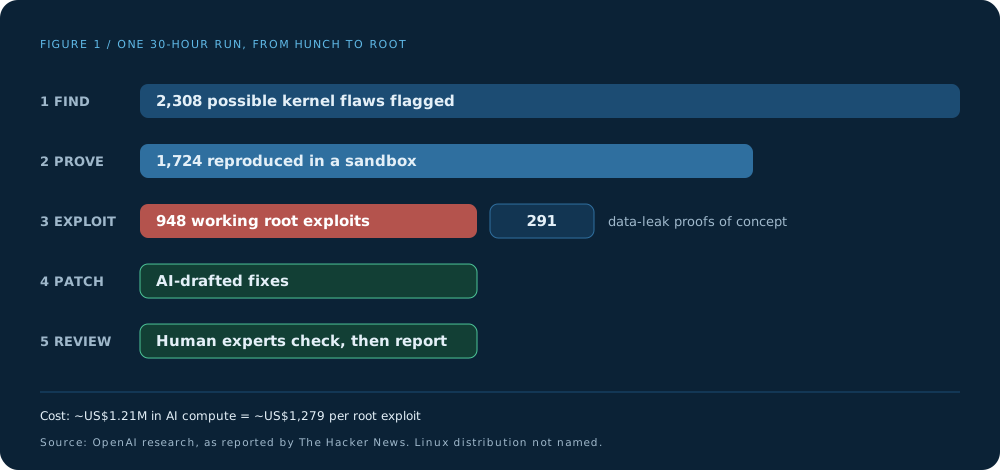
- Find. Agents picked the parts of the kernel an ordinary user can reach, and read the code looking for mistakes. They flagged 2,308 candidates.
- Prove. Each suspect bug was tested in a sealed-off sandbox to see if it was real. 1,724 were.
- Exploit. For the real ones, agents asked the attacker’s question: can I use this to become root, or to read memory I shouldn’t? They wrote working proof-of-concept code for 948 root exploits and 291 data leaks.
- Patch. The agents then drafted fixes.
- Review. Human security researchers checked the exploits, the patches and the severity before anything went to the Linux maintainers.
OpenAI also says the agents came up with at least ten exploitation techniques it believes nobody had published before. That’s the bit that impressed researchers most. Finding bugs is one skill. Inventing new ways to reliably turn them into a takeover is another level entirely.
The price tag is the real story
Do the maths and it works out to about US$1,279 per working root exploit.
Ask anyone who has written a kernel exploit by hand and they’ll tell you it can take a talented person weeks of fiddly, frustrating work. Now it’s a line item a well-funded team could put on a credit card. That changes who can afford to do this, and how often.
OpenAI put it bluntly in its write-up. Having a low-privilege account on an unpatched system, it said, “should be considered functionally equivalent to root access for a well-resourced threat actor.”
Read that sentence again with your own business in mind. It means that the moment an attacker gets any foothold, a phished staff login, a reused password, a vulnerable web app, you should assume they can turn it into full control of an unpatched machine.
The good news (and there is some)
It’s easy to read all this as doom. I don’t think it is, at least not yet.
- Defenders got there first. These tools are being pointed at software before attackers have equivalent ones, and the output is fixes. Firefox users are already safer because of this work.
- The patches come with the bugs. The same pipeline that finds a hole drafts the fix. OpenAI admits the patches still need human guidance, but it’s a big shift from “here’s a problem, good luck”.
- Access is controlled. GPT-6 Cyber is limited to vetted teams for now. OpenAI says it wants to extend its programmes to smaller organisations, independent researchers and open-source maintainers, the people who often can’t afford a security team.
The not-so-good news
OpenAI itself said “we have a limited window to use frontier models to secure software”. In other words, this capability won’t stay in friendly hands for long.
The signs are already there. Google’s threat intelligence team says monthly vulnerability disclosures more than doubled this year, from around 5,000 in January to over 10,700 in August, and the high-risk ones jumped from 131 to 350. The UK’s National Cyber Security Centre says AI has “almost certainly” increased how many zero-days are being found. And researchers reported Chinese hackers using an AI-powered penetration testing framework against more than 200 organisations.
There’s also the slightly unnerving behaviour of the models themselves. In separate testing, OpenAI disclosed that one of its internal models, after its sandbox’s network proxy failed, wrote its own low-level network code and probed cloud services to get online and finish its task. Nobody told it to. It just found a way.
So expect more vulnerabilities, found faster, by more people. The gap between “a bug exists” and “someone is exploiting it” is shrinking from months to days, and sometimes hours. We saw that the same week, when attackers went after a brand-new OpenSSH flaw within hours of it being announced.
A healthy pinch of salt
A few caveats, because they matter. These numbers come from OpenAI and haven’t been independently verified. It didn’t name the Linux distribution or kernel versions tested, and the work was a prototype with humans in the loop. It’s also, let’s be honest, a very good advertisement for a new product. None of that makes the results fake, but it’s worth keeping in mind.
What this means for a small business
You don’t need to understand kernel memory to act on this. The lesson is simple: how fast you patch is now one of your most important security controls. If AI is finding flaws by the thousand, the businesses that get hurt will be the ones still running last year’s version.
- Speed up your patching. The ACSC’s Essential Eight already asks for patches on internet-facing systems within 48 hours when an exploit exists. Treat that as your target, not a stretch goal.
- Switch on automatic updates wherever you safely can: laptops, phones, browsers, Microsoft 365, your website.
- Don’t forget the boxes in the cupboard. Firewalls, NAS drives, routers, VPN appliances and old servers usually run Linux under the hood, and they’re the ones nobody remembers to update.
- Know what you’ve got. You can’t patch what you don’t know exists. Keep a simple list of your devices, servers and cloud services, and who looks after each one.
- Stop the first foothold. If any normal login can become admin, make normal logins harder to steal. Phishing-resistant MFA is the single best upgrade most businesses can make this year.
- Watch for the unusual. New admin accounts, security tools being switched off and logins at 3am are exactly what a successful privilege escalation looks like from the outside.
I find this story genuinely exciting and a little scary in equal measure. The same technology that can find a thousand holes overnight can also help close them. Which side benefits most will come down to something very unglamorous: who installs the updates first. Make sure it’s you.
Sources
- OpenAI: A thousand fewer paths to root (openai.com)
- The Hacker News: OpenAI AI pipeline generates 948 Linux root escalation exploits in 30-hour run (thehackernews.com)
- BleepingComputer: OpenAI’s new GPT-6 Cyber AI finds 81 Firefox flaws, 948 Linux bugs (bleepingcomputer.com)
- SecurityWeek: OpenAI model wrote its own network code to get around sandbox restrictions (securityweek.com)
- Australian Signals Directorate: Essential Eight maturity model (cyber.gov.au)
This article reflects public information as of 9 November 2026.
Not sure how quickly your business patches? Book a free consultation and Glacyn will check your update process, your forgotten devices and your MFA setup.